


Comparing IoT Platforms for kWh Energy Monitoring: Firebase vs Telegram vs Blynk
 View
View
After implementing the core hardware and firmware for the IoT-based kWh monitoring system, the next major challenge was selecting the most suitable cloud and user interaction platform. Over several iterations, I tested three different approaches: Firebase Realtime Database, Telegram Bot integration, and Blynk IoT dashboard.
Each platform offers distinct advantages and trade-offs depending on system requirements, scalability, and deployment environment.
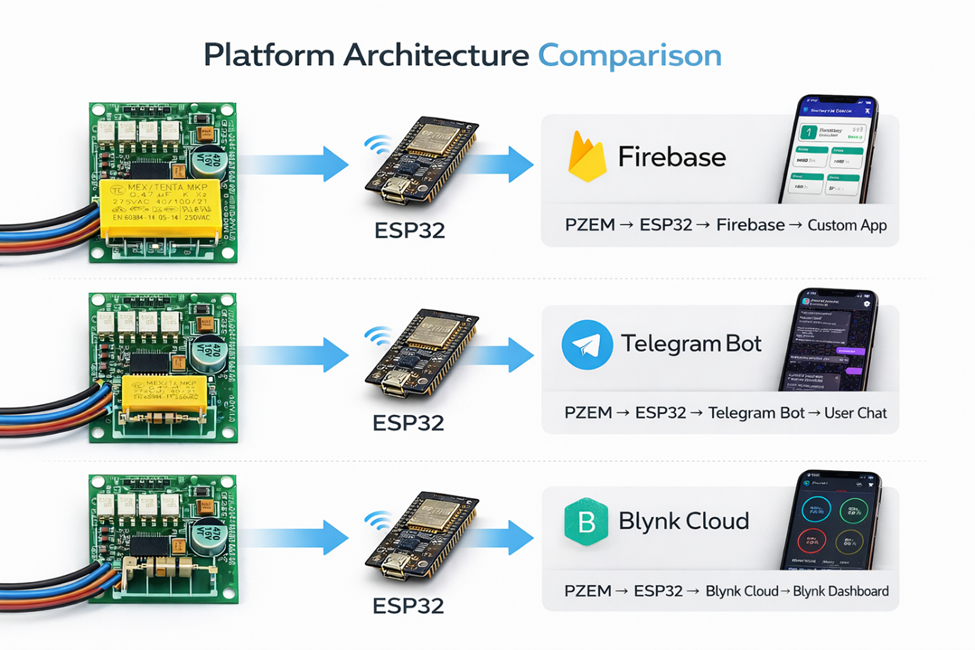
1. Firebase Realtime Database
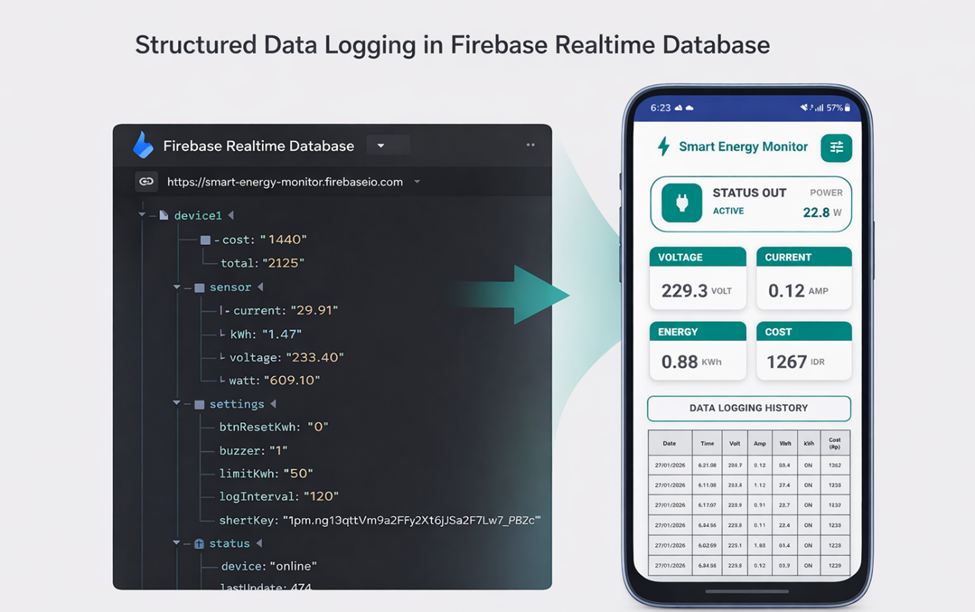
Firebase was used as a structured cloud backend for real-time data synchronization.
Strengths:
- Structured JSON-based database
- Real-time synchronization
- Scalable for multiple devices
- Suitable for custom Android applications
Firebase allows clean separation between measurement logic and cloud storage. Data such as voltage, current, power, energy, cost, and alert flags can be stored in a hierarchical tree structure.
Because it operates over HTTPS, it provides relatively secure communication. It is well-suited for systems requiring long-term historical logging and structured data management.
Limitations:
- Requires database configuration
- Requires authentication token handling
- Slightly more complex setup
Firebase is ideal when building a structured IoT ecosystem with custom front-end applications.
2. Telegram Bot with Google Sheets Logging
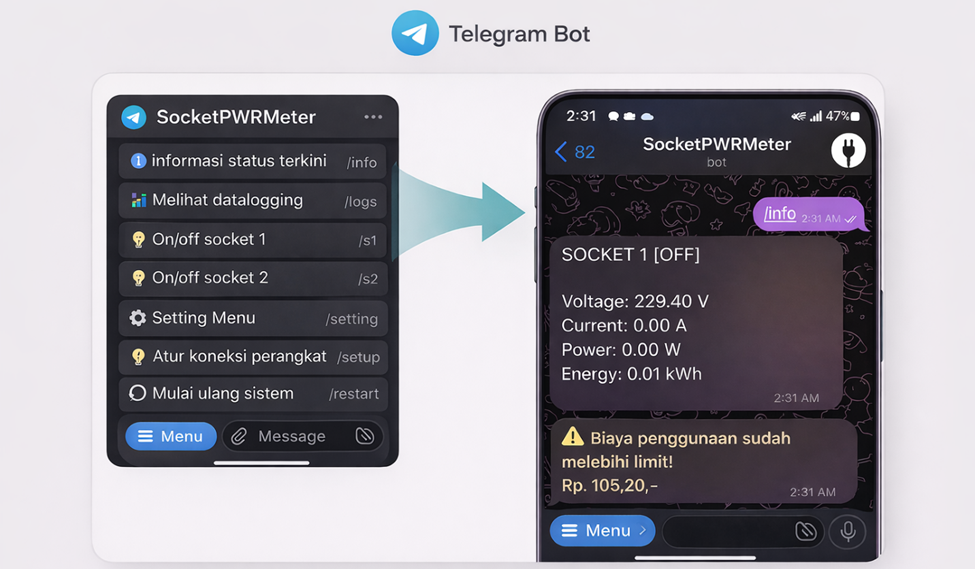
The Telegram version focuses on command-based monitoring and notification.
Strengths:
- No dedicated mobile app required
- Simple user interaction via chat commands
- Easy alert notification
- Google Sheets integration for logging
Users can send commands such as /info or /logs to retrieve real-time energy data. When energy thresholds are exceeded, instant notifications can be sent automatically.
Google Sheets integration provides simple historical logging without complex database setup.
Limitations:
- Less structured compared to Firebase
- Command-based interaction is less visual
- Dependent on Telegram server availability
This approach is effective for lightweight monitoring systems or quick deployment scenarios.
3. Blynk IoT Dashboard
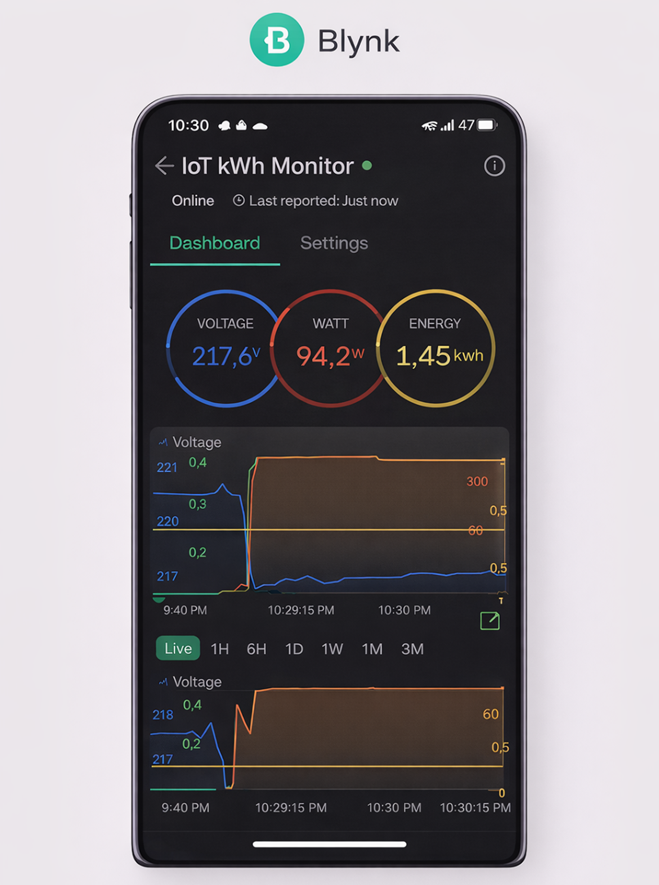
Blynk provides a graphical dashboard interface for IoT devices.
Strengths:
- Real-time graphical widgets
- Built-in notifications
- Minimal backend setup
- User-friendly mobile interface
It allows fast visualization of voltage, current, power, and energy values using gauges and charts.
Limitations:
- Dependency on third-party platform
- Limited customization compared to full backend control
- Long-term scalability may require subscription plans
Blynk is suitable for rapid prototyping and demonstration purposes.
4. Technical Comparison Summary
From an engineering perspective:
- Firebase provides structured and scalable backend control.
- Telegram offers simplicity and direct notification capability.
- Blynk emphasizes user-friendly visualization.
For long-term deployment and multi-device systems, Firebase is the most flexible. For alert-based monitoring, Telegram is efficient. For quick UI development, Blynk is practical.
5. Technical Comparison Table
| Feature | Firebase Realtime DB | Telegram + Google Sheet | Blynk IoT |
|---|---|---|---|
| Data Structure | Hierarchical JSON | Flat log-based | Widget-based |
| Real-Time Update | Yes | On request / event-based | Yes |
| Historical Logging | Full database | Google Sheets logging | Limited / dashboard-based |
| Alert Notification | Via cloud logic | Direct chat notification | Built-in notification |
| UI Customization | Fully customizable (custom app) | Command-based | Predefined widgets |
| Setup Complexity | Medium–High | Medium | Low |
| Scalability | High | Medium | Medium |
| Platform Dependency | Google Firebase | Telegram + Google | Blynk Cloud |
| Suitable For | Structured IoT systems | Lightweight alert system | Rapid prototyping & demo |
6. Final Insight
Selecting an IoT platform is not purely a technical decision; it depends on the balance between control, scalability, simplicity, and maintenance.
Through iterative development, this kWh monitoring system evolved from simple remote display to a modular IoT architecture capable of adapting to different cloud ecosystems without modifying the core energy calculation firmware.
#Embedded# #ESP32# #iot# #internetofthings# #firebase# #android# #telegram# #blynk#
 #Embedded#
#ESP32#
#iot#
#internetofthings#
#firebase#
#android#
#telegram#
#blynk#
#Embedded#
#ESP32#
#iot#
#internetofthings#
#firebase#
#android#
#telegram#
#blynk#
Sign In Or Register Comment after
No comments yet. Be the first to comment!